The Crown of Love
In this 3rd installment of our series on the Heart of Christ, we will reflect upon the symbolism of the crown of thorns, which shows us that the royal love of heaven is a humble love, friend of suffering, and powerful, in an uncontrolling way.
“Then Pilate took Jesus and had him flogged severely. The soldiers braided a crown of thorns and put it on his head, and they clothed him in a purple robe. They came up to him again and again and said, “Hail, king of the Jews!” And they struck him repeatedly in the face.”
King of a Different Kingdom
Many saw Jesus as "king of the Jews" in both his life and death. For some, this was a favorable title, for they wanted a powerful leader who could overthrow the oppressive Roman Empire and liberate the Jewish people. For others, this meant Jesus was a threat to peaceful social order and to the power of leaders and lords.
Yet, when Pilate asked Jesus if he really was the king of the Jews, Jesus answered, "my kingdom is not of this world." (Jn18:36). For Jesus was not a king like the any of the kings we know. And while he was “of the Jews” by heritage, his kingdom was not restrictive by race or tribe. His kingdom was, and is, available to all. Or at least, to all who reject the “powers of this world” (like control, domination, and self-centeredness) in exchange for the “powers of heaven” (like abandonment, freedom, and generosity).
For the territory of this kingdom is not a physical area measurable in kilometers, but a spiritual territory, measured by the thriving of all who live within it.
The citizens of the kingdom are not those with visible documentation, but with invisible hearts turned towards God.
The borders of this kingdom are not drawn on political maps, but are drawn within the hearts of those learning to navigate the life of this kingdom.
And the treasuries of this kingdom are not filled with earthly wealth, but with heavenly gold — the riches of renewed minds, joyful community, and perfect peace.
There is no waiting process to enter Jesus' kingdom. No paperwork to fill out. Not a single guard to police the walls. The gates have been unlocked and are thrown open! And yet, to live in the kingdom is, by definition, obedience of the kingdom’s laws (which is to say, to live in love of one another) and to submit oneself to the authority of the King (which is to say, to love God above everything else). Anyone who is still clinging to earthly power, control, popularity, and wealth cannot enter the kingdom, not because the kingdom is not there for them, or becuase God kicks them out, but because they have no desire to play by the rules of love.
“🎶The kingdom of God is justice and peace
and joy in the Holy Spirit
come Lord and open in us
the gates of your kingdom.🎶”
Uncontrolling Power
Now the ruler of this different kind of kingdom must be a different kind of king. Indeed, he is not a mere king or lord, but as the Bible says, "King of kings and Lord of lords!" (Rev19:16). Now, does this language intend to communicate that Christ is merely the most powerful king?… or that he’s a king of a different ontological order? You see, the defining feature of kings and lords is that they have power and authority… yet in this world, this power and authority are often ill-gotten and abused… and Christ cannot be complicit in that kind of power. The power and authority of Christ must, of course, be both legitimate and non-violent.
But what does that look like? While lords of this age wield power over others, Christ gives power under others. His is an em-powering force, supporting the growth of others. Compared with the typical “king,” Christ reverses the directionality of power, for in God's hierarchy, it is not the ones at the top of the ladder that have power, but those at the bottom — those who support others up it. There are many “ladders” that this holds true for — the perceived tiers of wealth, knowledge, charisma, achievements, maturity, etc. Imagine if you lived in a world where the rich empowered the poor, the educators empowered the learners, the popular empowered the friendless, and all those with a little extra gave to those who needed a little more.
The crown of Christ is a crown of power, but never a power to control or dominate. It is an uncontrolling power — the kind of power the ground has, which supports the life of all which walk upon it. It’s the power of the air, which gives itself into the breath of living things. “For in God, we live and move and have our being” (Acts17:28) I want to be clear: God’s uncontrolling power is certainly not weak (nothing would exist without it), but it’s also not “power” in the sense many today think of it. Uncontrolling power (which as it so happens, is also the power we see in math, physics, and biology) is both affording and constraining. It is active and passive (and thus it’s participatory). It can only empower because it simultaneously provides boundaries/shape and leaves room/space by giving itself to recipients of its power.
So we can rightly say that Christ, the true kingliness behind all kingliness, has all the power and all the authority — but only because he perfectly images God who gives His power away! Christ could have summoned twelve legions of angels to prevent his torture and execution (Mt26:53), but he let himself be humbled to the point of death, choosing not to assert his life and power, but instead to give it away — submitting to the natural order… to other people… and ultimately to God.
In the present day, Christ continually empties his power and authority into his followers, allowing them to be his body on earth, carrying forth his work, not by controlling them, but by supporting them. Christ Jesus is no authoritarian leader. He models self-emptying power and inspires others to do the same. His strength is found in what the world calls weakness.
Jesus taught that the truly great person makes herself little, like a child (Mt18:4), and the most honorable person chooses to take the position of least honor (Lk14:10). He modeled this by taking the lowest possible role amongst his disciples, washing their feet (Jn13:5), and even today lets his very body be subject to the priest and the believer. Thus, the King of Love is servant to all.
“For everyone who exalts himself will be humbled, but the one who humbles himself will be exalted.”
Friend of Suffering
Each thorn in the majestic crown of Christ is a sign of humility and of suffering. It teaches us that love is willing to be humiliated and to undergo much pain… as long as it is for the good of those one loves.
Ah! How well Christ knows suffering! Even from his youth, his life was full of thorns. Suffering was his continual, cherished companion. She was with him in the traumas of fleeing home and living as stranger in foreign Egypt. She was his company while he mourned his father Joseph’s death. For each sick or downtrodden person Christ’s heart grieved for, she offered another thorn. Jesus drew close to suffering in his fasting from food, pleasures, and (worldly) power. And finally, he embraced suffering at Gethsemane and allowed her to lead him through the tortures of crucifixion!
Love befriends suffering, while seeking to alleviate all suffering of others. St. Therese of Lisieux understood the valuable role of suffering in life, and saw that she could, like Christ, find suffering to be a valuable comrade. She said, “The more crosses I encountered the stronger became my attraction to suffering” and "A day of a Carmelite spent without suffering is a day lost." Yet despite her affinity for suffering, she also says "I would never ask God for greater sufferings." I think she knew that life presents plenty of thorns for us to work with. For the point is never to pursue suffering for its own sake, but to allow Love to bring goodness out of suffering — joy out of mourning. For the path of Christ redeems suffering, turning it into a crown of glory! As Therese says: "I rejoice that God still lets me suffer for love of Him!"
“I understood what real glory was. He whose Kingdom is not of this world showed me that true wisdom consists in “desiring to be unknown and counted as nothing,” in “placing one’s joy in contempt of self.” Ah! I desired that, like the Face of Jesus, “my face be truly hidden, that no one on earth would know me.” I thirsted after suffering and I longed to be forgotten.”
“My folly lies in the hope that Thy Love accepts me as a victim… As long as Thou wiliest I shall remain with my gaze fixed upon Thee, for I long to be fascinated by Thy divine eyes, I long to become Love’s prey. I am filled with the hope that one day Thou wilt swoop down upon me, and bearing me away to the source of all Love, wilt plunge me at last into its glowing abyss, that I may become for ever its happy victim.”
The crown of Christ, twisted and bleeding, is the symbol of true kingship… which is to say, true servant power. It is this glorious crown that is the path to redemption, resurrection, and eternal life — not a comfortable crown of gold and jewels, but of thorns and roses — the willingness to suffer for the sake of beauty and love. Thus, Christ is the true king of kings, who rules through empowerment, drawing all things together over his sacrifice, ruling in heaven with all those willing to share a thorn of his crown.
This is post 3 of a 7 part series. The next post is on the Cross of Love.
Photo Credits:
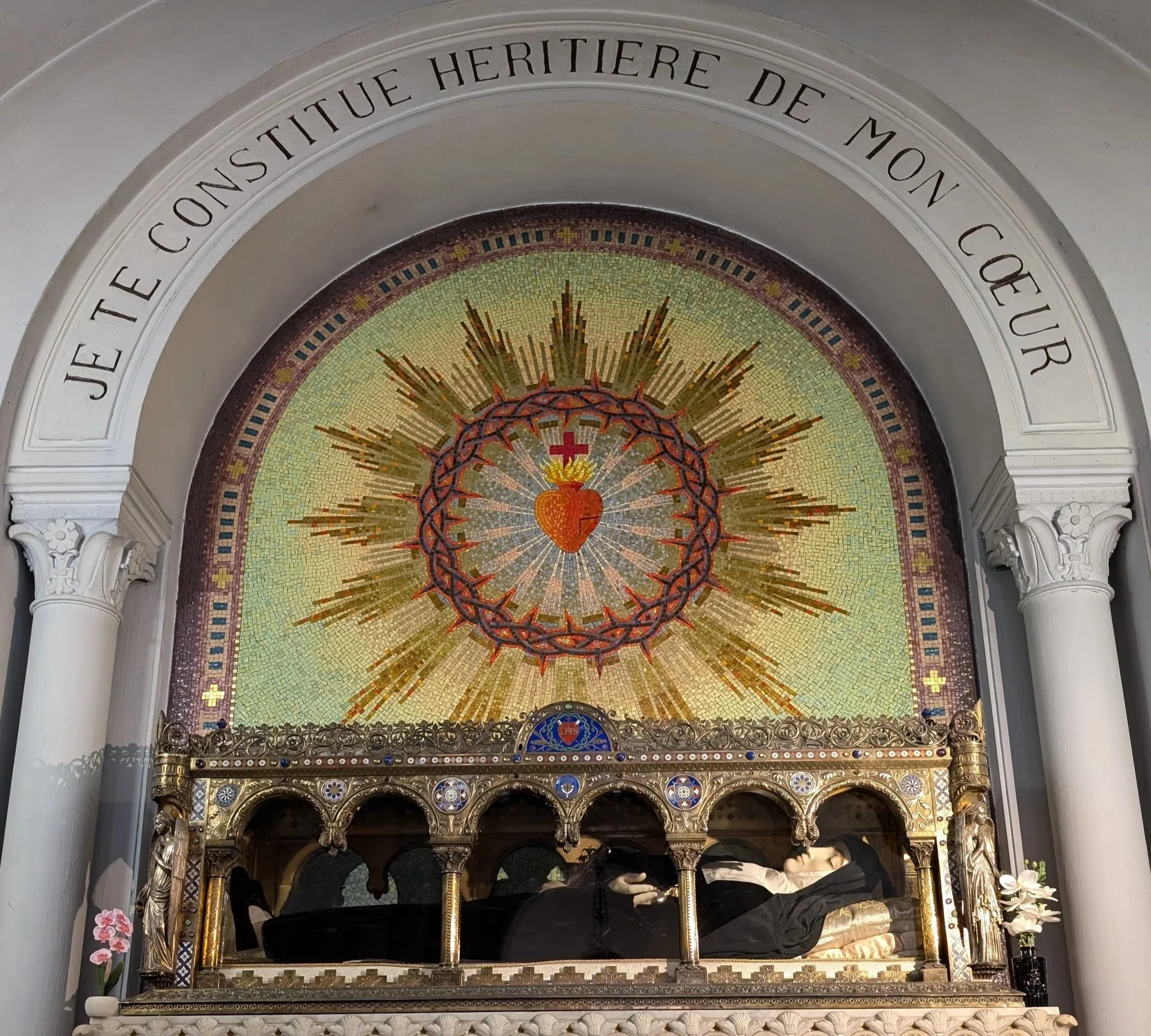
The tomb of Margaret Mary Alacoque, photo taken myself at Paray-le-Monial, 2024.
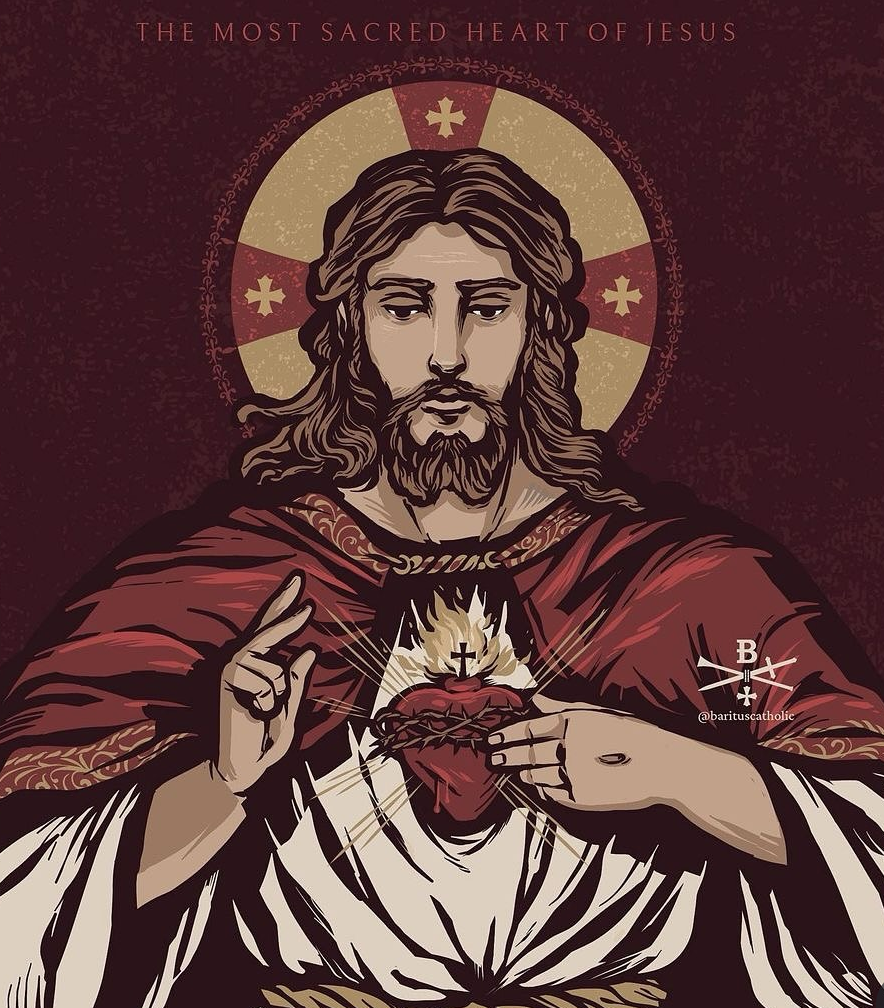
Artwork by Baritus Catholic, (Etsy) (Instagram).
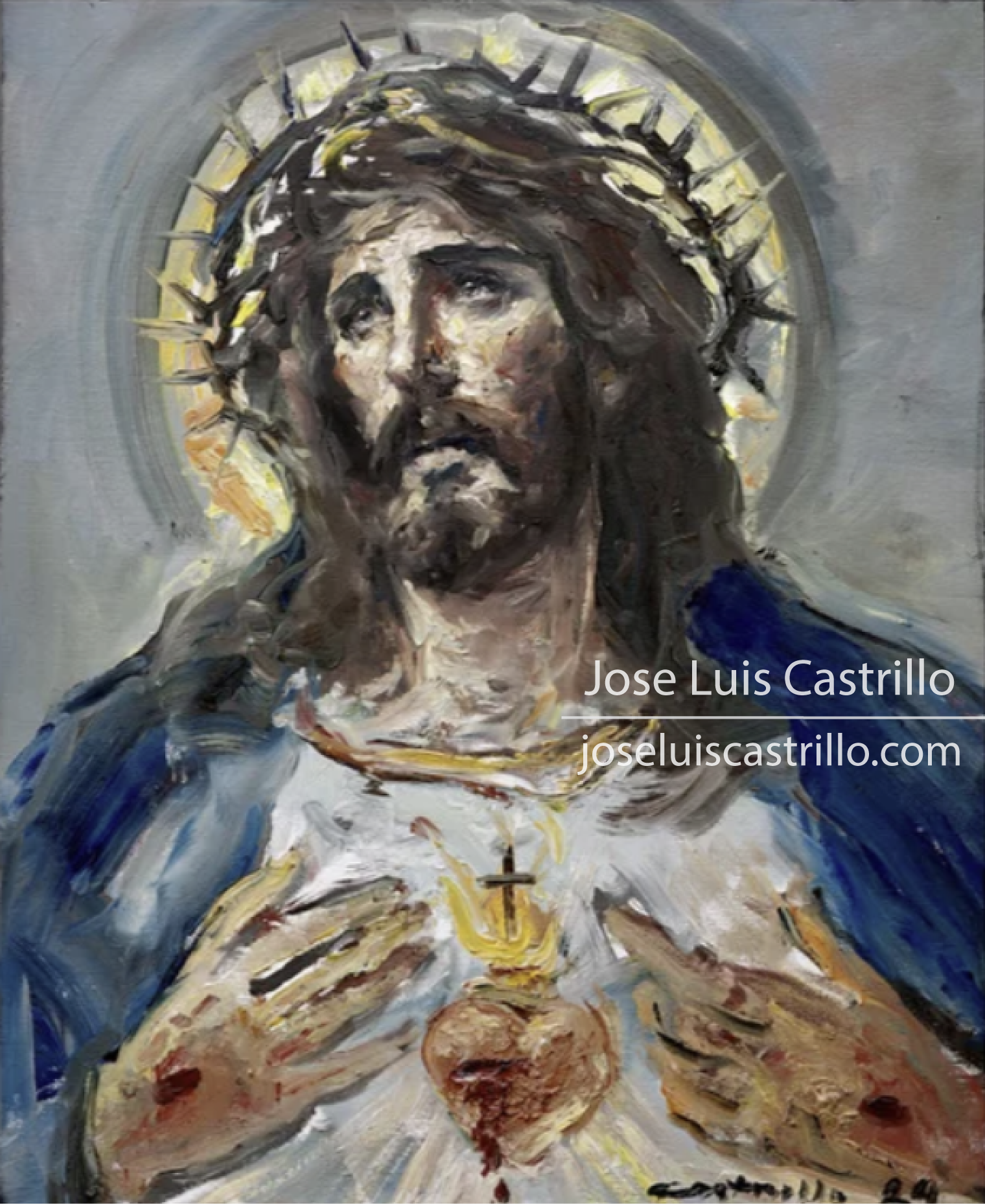
Artwork by Jose Luis Castrillo (browse his website here) (Instagram).
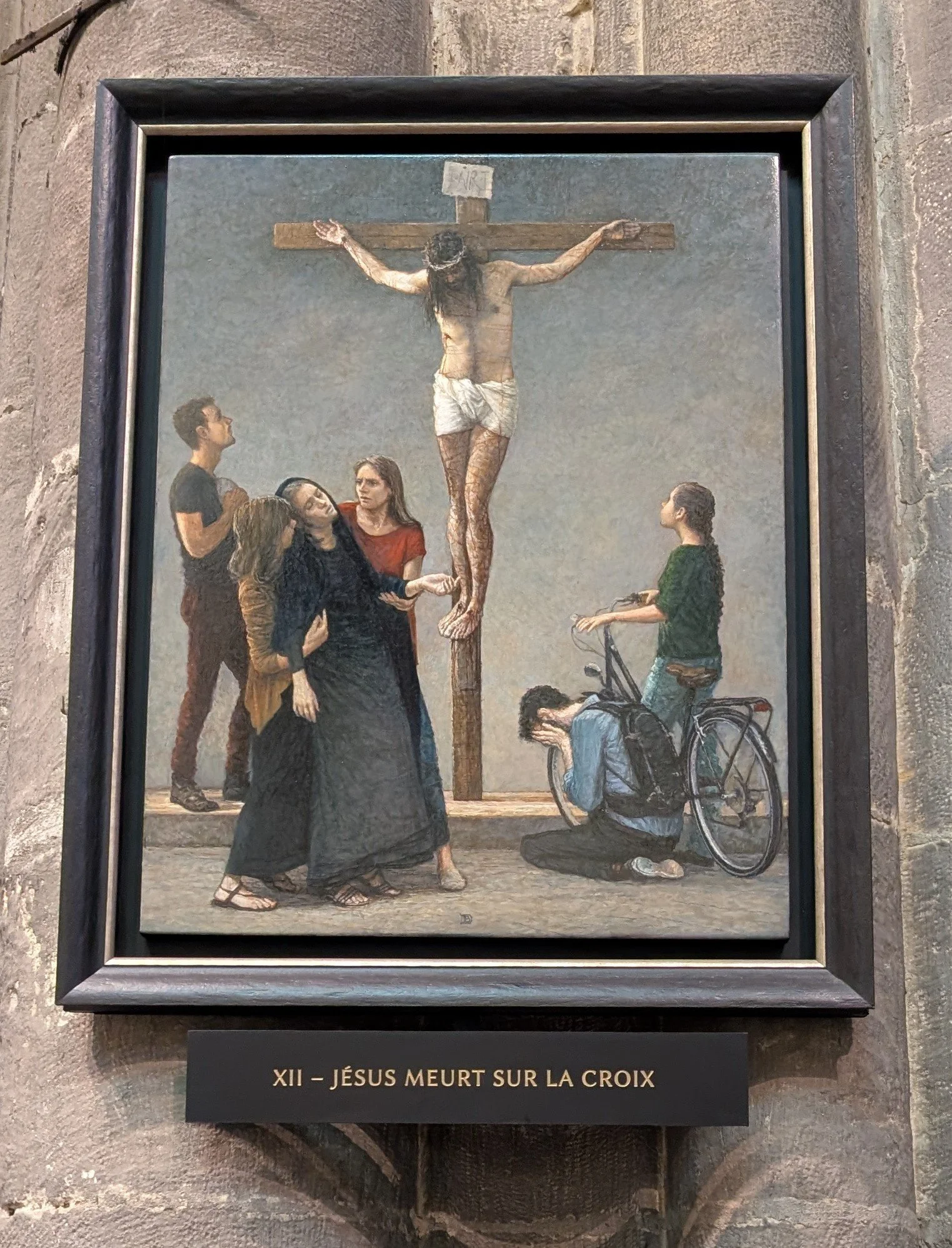
Painting I found at Église Saint-Nizier in Lyon France, 2025.