The Cross of Love
In this instalment of the Sacred Heart series, we will consider how the symbol of the cross of Christ teaches us about the nature of love, and helps us participate in love!
At its core, the symbol of the cross is an intersection of opposites — a unity of dichotomies. This is seen in its very shape, which is two, oppositely oriented, intersecting beams (the significance of which will be discussed more later). And this is a fitting symbol for Christ, who is the first and the last (Rev 21:6), the highest and the lowest (Eph4:10), the greatest and the least. (Mt23:11) (I’ll let you decide how literally or narratively true you think those descriptors are :) )
Many of the earliest Christians did not wish to associate with the cross. It was, after all, the empire's tool for brutal execution, and a reminder of the shameful way Jesus was put to death. Yet, over time, followers of Jesus came to understand the crucifixion of Christ as so deeply valuable, that the cross became not a symbol of violence or shame for Christians, but a symbol of joy and redemption! What a mysterious turn of theology! The cross, in the full context of the Christian story, unites the dichotomy of suffering and joy — and of death and life.
Upon the cross, the self-sacrificially loving way of Christ, which is ultimately unitive and restorative, is epitomized and revealed. Many Christians for centuries have found it to be the point of greatest revelation — the greatest kairos (vertical time) moment, which wraps around and stretches through the entire story of existence — with symbolic-mediating weight of such magnitude that it unites the heavens and the earth, it redeems all wrongs, and it brings all peoples together as one. Jesus invites us into this very love saying to us, "take up your cross." (Mt16:24) Through gazing upon the cross of Christ (and I mean a real gazing for minutes and hours), I have been deeply moved to see this gruesome point in time as the supreme love display, and thus experience the salvific power of he who was lifted up like a snake in the desert. (Jn3:14)
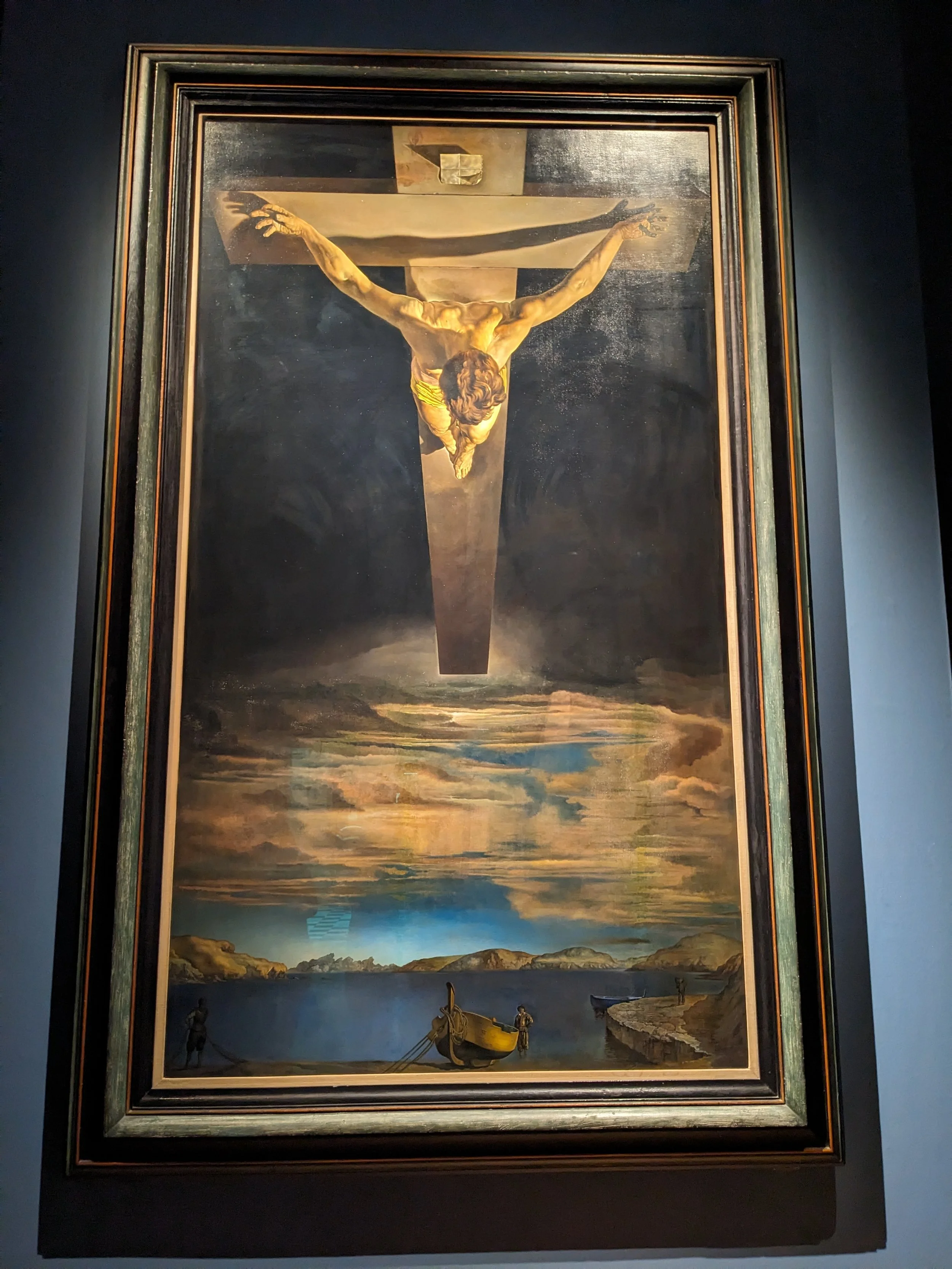
“He who descended is the same one who ascended far above all the heavens, so that he might fill all things.”
Voluntary Necessity
Love must be freely given and freely accepted. It cannot be forced or coerced! It is the nature of love to be a free choice. We see that Jesus, despite knowing the great pain he would have to undergo, freely chose to continue walking the path to his cross… “Look, [Jesus said] we are going up to Jerusalem, and the Son of Man will be handed over to the chief priests and experts in the law. They will condemn him to death… mock him, spit on him, flog him severely, and kill him." (Mk10:33-34)
Why did Jesus do this? Why would he choose such a terrible fate? Because he was drawn by love. He embodied his own summation of the law: to love God and love others. (Mt22:26-39) Even though Jesus was under great anguish in facing his fate (Lk22:33-34), what he wanted most was to love his Father in heaven, honoring and obeying what he knew in his heart was his highest calling!
When we truly love someone, we are willing to go to great lengths for them… and not just willing… it's what we want to do. Jesus was drawn to the cross because he wanted to do everything he possibly could for the people he loved…
And this brings us to the dichotomy of love as voluntary necessity: Love compels me, yet I also freely chose it. When I deeply love someone, I'm drawn to them in a way which demands something of me, yet I don't feel like my agency is being taken away. In caring for them, I feel as though I'm expressing my agency even more fully! Though it may be paradoxical, sacrificing myself for the sake of love is simultaneously the most natural instinct I can fulfill, and the most ultimate expression of my free choice!*
*Harry Frankfurt coins the term “voluntary necessity.” The more we (voluntarily) conform our will to particular values, the more going against them becomes unthinkable, and the more we must do what our values demand. Agape (ἀγάπη) love is the prime example of this — to love someone imposes necessities upon us — we must care. And yet to submit myself to the demands of love is the most authentic expression of my freedom.
“If anyone wants to become my follower, he must deny himself, take up his cross, and follow me.”
Generative Self-Sacrifice
John says that “there is no greater love than this: to lay down one's life for one's friends.” (Jn15:13) This is what Christ did upon the cross. I imagine that during his passion, Jesus thought of the many people he loved: he gazed upon his dear mother, and his beloved John… he considered all his friends throughout his life… he thought of his enemies and those nailing him to the cross… he thought of all the people he loved and wanted to help in this life but couldn't… for he only had so much time and energy in his short time on earth… but now, upon the cross, he could do something for for all of these people! This was his ultimate fulfillment of his path, his obedience to love, his sojourn into the grave, so that all people — and in fact all things — could be united together in peace.
“He himself is before all things, and in him all things hold together . . . For in him all the fullness of God was pleased to dwell, and through him God was pleased to reconcile to himself all things, whether on earth or in heaven, by making peace through the blood of his cross.”
For those trying to follow the way of Jesus, the cross is both a terrible and beautiful calling! Our lives are not our own, but are free to be given up, whenever the circumstance may call for it. This can be true physically, as in the case of the martyrs… but spiritual martyrdom is even more pleasing to God! As Paul implores the Roman church: "present your bodies as a living sacrifice, holy and acceptable to God, which is your reasonable act of worship." (Rm12:1)
This is not just sacrifice for the sake of sacrifice — but purposeful, generous, fruitful self-sacrifice — the kind of sacrifice that all life and all of reality is made of! How is this the case? Consider this: For a child to survive, her parents must sacrifice for her. For a society to survive, all its members must sacrifice for it — submitting themselves to the collective good. For the global ecosystem to survive, all species must sacrifice themselves into the harmony of the ecosystem. Even our planet is the result of “self-sacrifice” — first of stars which exploded into stardust — then of all the dust and accumulating rocks “giving” themselves into the whole of the planet. Certainly, I’m stretching language a bit to attribute “sacrifice” to rocks — but the point I’m getting at is that this pattern — the pattern of gift-of-self (of “sacrifice”) which generates a greater unity — is found across all levels of reality!
The Christian claim is that Christ crucified is the climax of this pattern of unity-generating self-sacrifice! In giving himself away, Christ became the nexus of a new cosmic order — that of a united heaven and earth (as will be discussed shortly).
On a very practical level, this example of crucified love is what all Christians are called to emulate, for it is, in fact, the only way to live in accordance with reality. Christ crucified reveals that the true Way of God is one of loving self-sacrifice — a love which is, among other things, generative, humble, forgiving, and unconditional.
“For it is in giving that we receive,
it is in pardoning that we are pardoned,
and it is in dying that we are born to eternal life.”
St. Thérèse was a master of making "little sacrifices" throughout her day. She would smile at people she had a natural aversion to… refuse to turn and look at the annoying nun making noise during prayer… allow herself to be criticized for another nun's mistakes. With every little "sacrifice" of her own comfort and pride, she let Christ shape her heart to be more like his. She knew that “true love grows by sacrifice” and seized upon every opportunity to fast from her desires. Even when pain and suffering was inflicted upon her, be it physical illness, relational rejection, or apathetic darkness… she re-framed her suffering as an opportunity to suffer alongside her beloved Christ, imaging him more fully.
“I really feel that I would have no disappointment, for when one expects pure and unmixed suffering, the smallest joy becomes an unhoped-for surprise. And you know, Mother, that suffering itself becomes the greatest joys when one seeks it as the most precious of treasures.”
When we participate in the pattern of Christ, we share in the faith, hope, and love of Christ! And, in fact, we enhance this very faith, hope and love! (1Jn4:12) Some Christians like to debate if this participation in Christ is one of passivity — simply accepting the “perfection” of Christ (Heb12:2) — or one of activity — by which we benefit our world and Christ himself by our choosing this pattern of love (Col1:24). Of course, the answer is that it is both: any real participation must always be both passive and active. As I suffer through this life (passively) given me, I can (actively) choose to respond in generative, loving ways, by which I become a little Christ, carrying my little cross.
When I encounter great trial and pain in this life, I see it as an opportunity for me suffer with Christ and participate in his redemptive work. I imagine that the crucified Christ himself is extending to me a splinter of his cross… inviting me into saving love…
“Fix your eyes on the crucified one and all will seem easy… Therefore dear sisters lay a firm foundation in seeking to be the least of all, and being a slave to others, watching how you can please and help them, for it will benefit you more than them.”
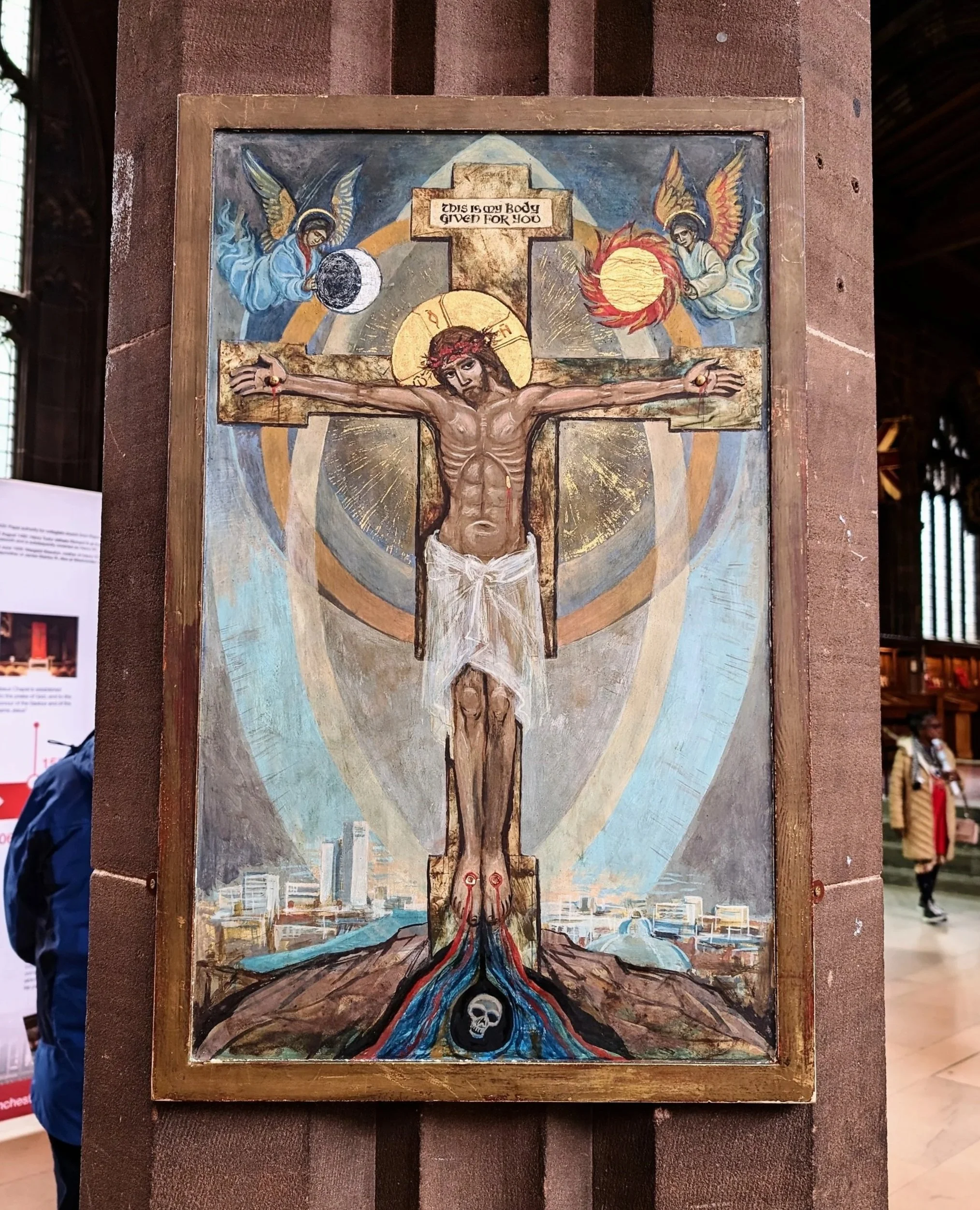
“He was supreme in the beginning and—leading the resurrection parade—he is supreme in the end. From beginning to end he’s there, towering far above everything, everyone. So spacious is he, so expansive, that everything of God finds its proper place in him without crowding. Not only that, but all the broken and dislocated pieces of the universe—people and things, animals and atoms—get properly fixed and fit together in vibrant harmonies, all because of his death, his blood that poured down from the cross.”
Union of Heaven and Earth
In the cross, there is a literal bringing together of the vertical beam, which points to Sky-Heaven, and the horizontal beam, which spreads out over the Earth. “Heaven” or “sky”* re-presents the invisible, immaterial, and eternal… while “Earth”* re-presents the visible, material, and temporal. Humanity, according to the Genesis 2 creation narrative, is literally composed of both heaven-stuff and earth-stuff — of “dirt” and “breath.” So each human is a “little intersection” (a little cross) between heaven and earth, insofar as we all have a body and a spirit-mind (a ruach or psyche).
*In the Bible, heaven and sky are the same word. Shamayim (שָׁמַיִם) in Hebrew are the (always plural) skies where birds fly and heavens where stars appear. Even in Greek, uranos (οὐρανός) is also both the sky and heavens (plural or singular). Both words are also used to describe the dwelling-place of spirits and God, as well as Godself.
*Earth is a bit simpler of a word. Eretz (אֶרֶץ) means land, ground, and earth.
The human purpose is to mediate between heaven and earth — something we do by the very nature of our constitution (as breathing dirt and God-imaging animals), and something we fulfill through choosing this mediation role to its fullest good — stewarding the earth in a heavenly way and aligning the material order with spiritual order, thus glorifying* the Lord. Each of us fulfill this purpose to greater or lesser degrees. And the Christian would say there is one who fulfills it most perfectly… Jesus Christ.
*“Glorifying” God literally means “to give God weight.” Kavod (כָּבוֹד) = weight, glory. We “give weight” to God by participating in the manifestation of heavenly reality in the visible world.
Jesus is the “great mediator,” the “great steward,” the “great aligner,” and the “great glorifier of God.” In him is the fullness of both heaven and earth. All that is of the spirit (all that is immaterial, thought, and consciousness) is subsumed into body in the incarnation of the Logos. And all that is of the body (all finitude, pain, and beauty) is subsumed into spirit (the eternal, perfect, and true) in the resurrection. Between birth and re-birth is death… in this case, a death upon a cross. The cross is the ultimate mediation point which binds both movements together into one.
And at the center of the cross is what? Christ crucified. Specifically, as often depicted in art (particularly in the Orthodox tradition), the Face of Christ is placed exactly at the intersection of the two beams, for the face is the visible image of the invisible soul.
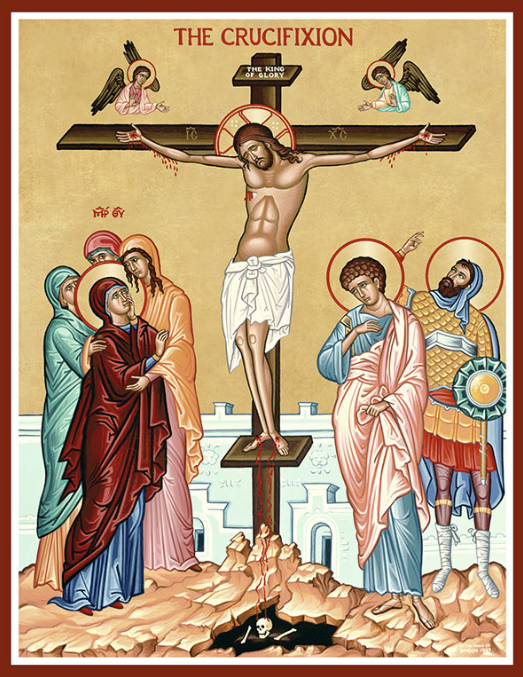
“Christianity is a superhuman paradox whereby two opposite passions may blaze beside each other. The one explanation of the Gospel language that does explain it, is that it is the survey of one who from some supernatural height beholds some more startling synthesis.”
The Tree of Life
The material of the cross is also relevant to our symbolic exploration, for being of wood, and placed upright, the cross taps-into an array of tree symbolism throughout the Biblical narrative, as the New Testament authors are keenly aware, referencing multiple times that "they killed [Jesus] by hanging him on a tree." (Acts10:39)
When a tree (or wood) is found atop a hill in the Biblical narrative, it references sacrifice and worship… sometimes properly oriented towards God, such as the wood of Elijah's alter on Mount Carmel (1Kg18:20) or the sacrifices on the temple mount in Jerusalem… other times oriented towards idols, such as Asherah poles on high places (Deut12:3). Jesus subsumes both images, as the fullest expression of sacrifice and worship.
The garden of Eden was the first high place with trees — the original harmony where heaven-meets-earth. The temple was meant to be a new uniting tree-on-a-hill, with fruit for all the nations. But it became corrupt (run by hypocrites, overly restrictive, commercialized, and exploiting of foreigners (Mt23:4, Mt21:13)) and Jesus condemned it for not bearing fruit, just as he cursed the fig tree! (Mk11:14) Instead, Jesus invites his followers to have faith that corrupt religion, with all its unfruitful trees, will be cast into the sea (Mk11:23), and everyone can live in peace, having their own, fruitful fig tree, free from fear. (Micah4:4)
Jesus then, becomes himself the symbol of the fruitful tree from which we can eat and be satisfied as with the richest of foods! While the fruit of the tree of the knowledge of good and evil leads to sin and death, the fruit of the cross defeats sin and death! When mankind (אָמָד: adam) takes and eats the fruit of the first tree, he sins and falls, grasping for power, believing he has claimed the knowledge of good and evil… yet when we today receive and eat the fruit of the cross, the body and blood of Christ, our sins are forgiven and we are lifted up, no longer grasping for what we already have, living in harmony with God's knowledge of good and evil.
Thus the cross on the hill of Calvary becomes the Tree of Life — the center of a new garden — the summit of delight (עֵדֶן: eden) — with leaves for the healing of all nations. (Rev22:2)
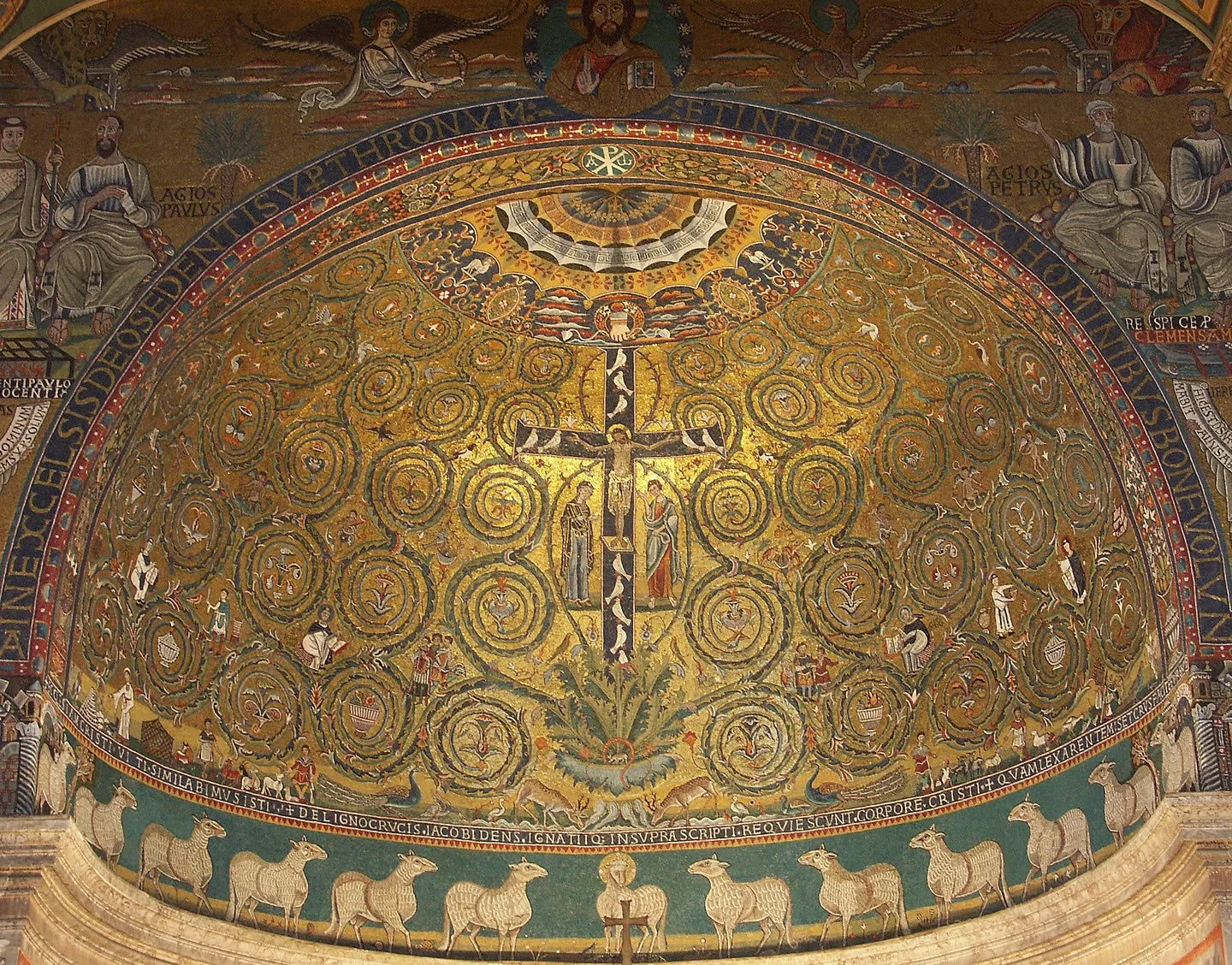
“As we contemplate the heart of Christ, the incarnate synthesis of the Gospel, we can, following the example of Saint Therese of the Child Jesus, “place heartfelt trust not in ourselves but in the infinite mercy of a God who loves us unconditionally and has already given us everything in the cross of Jesus Christ.”
This has been a lengthy article, and still there's so much I would love to say about the passion of Christ! There is more to come in the next article, The Blood of Love.
Image Credits:
Painting by Salvador Dalí, “Christ of Saint John of the Cross,” photo taken myself at Kelvingrove Art Gallery in Glasgow (2023).
Painting I discovered in Manchester Cathedral. I have not been able to identify the artist. Photo taken myself (2024).
“Crucifixion icon,” by Brother Simeon Davis, found at MonasteryIcons.com.
Mosaic called “Tree of Life” in the apse of Basilica San Clemente, Rome. More on its symbolism here.