The Light of Love
Now we arrive at the final symbol we will examine in our series on the Heart of Christ: the element of light!
We will consider how light is revelation… expansion… unified duality… and logos.
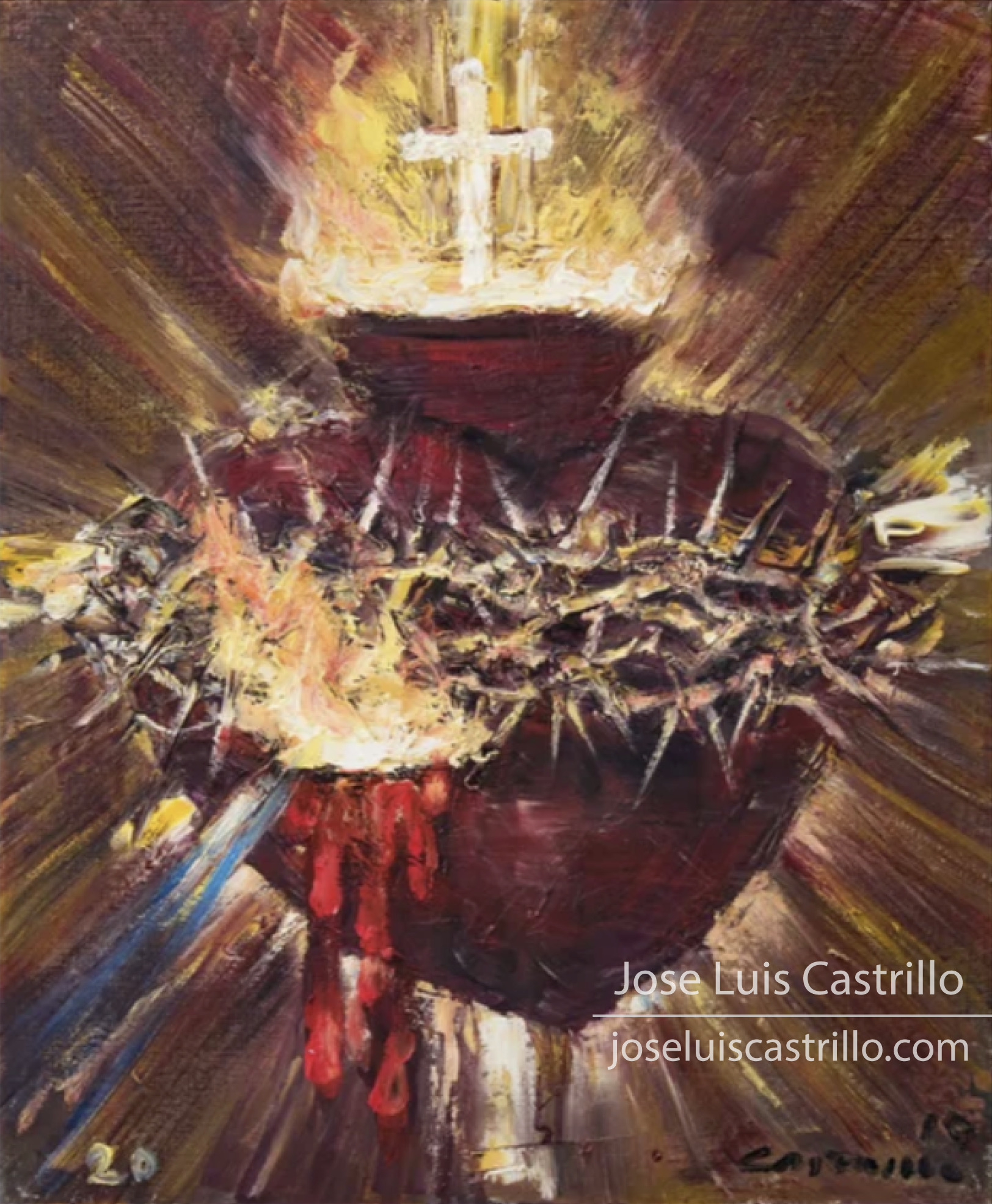
“You were at one time darkness, but now you are light in the Lord. Walk as children of the light.”
Light of Revelation
Light reveals. Rather than stumbling around in the dark, if I have light, I can see what's really there, and then act with greater discernment, and in greater harmony with what's around me.
Love is the same way. Love reveals the spiritual environment. And true love is a light that allows our hearts to see what is really there, enabling us living in greater accordance with reality.
When the love from Christ's heart shines upon us, it reveals everything with complete clarity! This is often scary, for we wish to keep all our own imperfections, shame, and sin hidden in darkness. The light of Christ can seem, then, quite invasive — stripping us naked — an embarrassment and offense to the one who isn't desirous of Love. Yet, for the one who loves God, this is a welcome intimacy.
“Nothing is covered up that will not be uncovered and nothing secret that will not become known.
Therefore whatever you have said in the dark will be heard in the light,
and what you have whispered behind closed doors will be proclaimed from the housetops.”
”I have come as a light to shine in this dark world, so that all who put their trust in me will no longer remain in the dark.”
This is why "revelation" is considered a time of judgement. For when the curtain of shadow is pulled back, we experience love’s apocalypse. (ἀποκάλυψις: unveiling, disclosing) And the question is… how shall we respond? When truth is revealed, do we cower and try to cover what can no longer be hidden (as Adam and Eve hid from God)? Or do we embrace the invasive, surprising, beautiful, and demanding reality? To do so requires faith that this is what is best for us, even if it's uncomfortable, painful, and requires us to change.
For myself, who hopes for the coming justice of full revelation, I want to prepare myself as best I can for this radiant light of love. So I ask myself, in my daily life, am I open to little unveilings — little apocalypses of love? When my darkness is exposed or I encounter humiliation, do I try to hide, defend myself, put up a mask?… or do I offer it to the Light? When I am graced to be pierced with a ray of Christ's apocalyptic love, will I take it as an opportunity to condition myself for heaven and let my eyes adjust to the Kingdom radiance?
Ah! Though it often hurts my pride and ego to be exposed… what a joy it is every time I am humbled… for my heart is opened a little more to the Light which knows me, and loves me all the same.
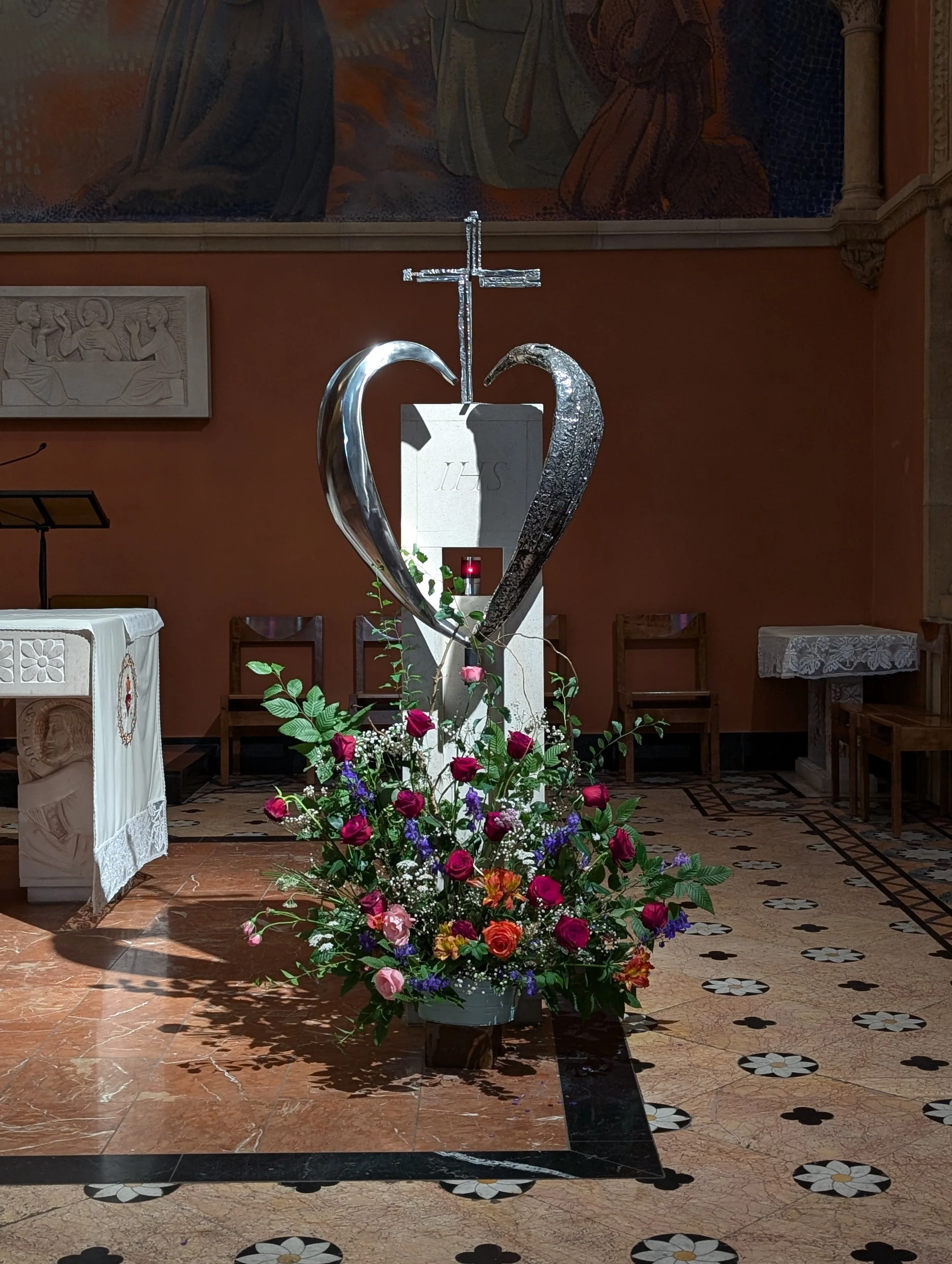
“May I learn to look at myself with the eyes of understanding and love.”
Light of Expansion
The love of God, like the light radiating from the heart of Christ, is always expanding outward — always moving, growing, and reaching out to others. For the love of Christ is not warped in on itself, but always shines out to others. We often get this wrong in the culture of the world, which thinks a strong “love” is exclusive, even possessive, directed at a particular “object” of love. Yet “love is not primarily a relationship to a specific person; it is an attitude, an orientation of character which determines the relatedness of a person to the world as a whole, not toward one “object” of love. If a person loves only one other person and is indifferent to the rest of his fellow men, his love is not love but a symbiotic attachment, or an enlarged egotism.” (Erich Fromm, The Art of Loving)
Love expands, and like light, does not grow weaker with distance, but remains consistently strong. Jesus spoke of loving both your neighbors and your enemies with the same, unconditional goodwill. This universal love is called “agape” (ἀγάπη). “Agape is disinterested love. . . . Agape does not begin by discriminating between worthy and unworthy people, or any qualities people possess. It begins by loving others for their sakes. . . . Therefore, agape makes no distinction between friend and enemy; it is directed toward both.” (Martin Luther King Jr.) And light does not discriminate between worthy and unworthy things to illuminate. Light simply shines! Perhaps different objects reflect or absorb the light more than others, but the light itself does not discriminate. Agape love does what it does, and others get to receive it whether they are worthy or not… for as Jesus says, the sun shines on both the righteous and the unrighteous. (Mat5:45)
Christ-like love does not pick and choose who is worthy of love. It cares for everyone and everything.
“Just as light radiates and communicates itself without diminishing, so the Son is the reflection (apaugasma) of God’s glory and the imprint (character) of his being (hypostasis) (cf. Heb 1:3; 2 Cor 4:4).”
Light of Unified Duality
Today, with all our scientific knowledge, light continues to gift us riches of contemplation. Consider that light is a wave-particle duality, which means it is both a continuous wave and discrete electron particles, completely, simultaneously. Interestingly, this sounds much like how Christianity has long understood Christ: as a divine-human duality — the continuous infinite and the discrete finite, both fully and completely.
The fact that light is both multiplicity and unity is part of how it manifests and symbolizes love. For love is unity in diversity — differentiated identities, "choosing" to become one, without losing their distinctness. “Unity in diversity” is one of my key definitions of love, and I love how CS Lewis describes this in The Screwtape Letters (note that in this quote, the speaker is a demon, and he refers to God as “the Enemy”):
“The whole philosophy of Hell rests on recognition of the axiom that one thing is not another thing, and, specially, that one self is not another self. My good is my good and your good is yours. What one gains another loses. Even an inanimate object is what it is by excluding all other objects from the space it occupies; if it expands, it does so by thrusting other objects aside or by absorbing them. A self does the same. With beasts the absorption takes the form of eating; for us, it means the sucking of will and freedom out of a weaker self into a stronger. ‘To be’ means ‘to be in competition’.
Now the Enemy’s philosophy is nothing more nor less than one continued attempt to evade this very obvious truth. He aims at a contradiction. Things are to be many, yet somehow also one. The good of one self is to be the good of another. This impossibility He calls love, and this same monotonous panacea can be detected under all He does and even all He is — or claims to be. Thus He is not content, even Himself, to be a sheer arithmetical unity; He claims to be three as well as one, in order that this nonsense about Love may find a foothold in His own nature. At the other end of the scale, He introduces into matter that obscene invention the organism, in which the parts are perverted from their natural destiny of competition and made to co-operate.”
Indeed, the unified duality of light is an excellent example of how the “contradiction of Love” is fundamental to our universe. For by studying our world, we can see how it reflects this underlying love, in all its aspects, but perhaps most clearly in light, which is the the active expansion of unity in diversity that reveals love to our eyes and gives warmth to our being.
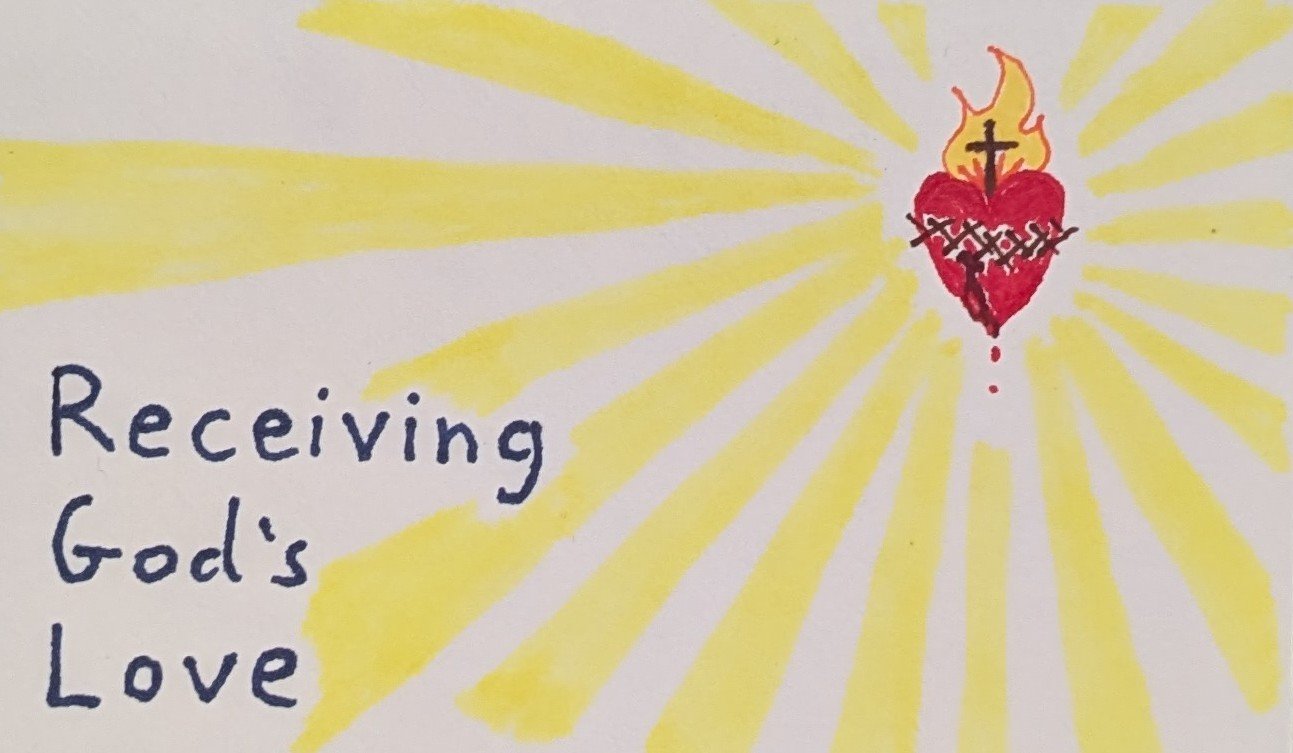
Light of Logos
Before bringing our reflections upon light to a close, let's get a bit more philosophical, for the light of the transformative symbol of Christ's Heart reminds us of how Christ is the Logos — the infinite Word. As John the Beloved expresses it…
“In the beginning was the Logos, and the Logos was with God, and the Logos was God. He [the Logos] was in the beginning with God. All things came into being through him, and without him not one thing came into being. What has come into being in him was life, and the life was the light of all peoples. The light shines in the darkness, and the darkness did not overtake it.”
What is meant by this Greek word, logos (λόγος)? It is a rich word, with a range of meanings, including "word," "speech," "reason," "principle," and "meaning," and was used in Greek philosophy to describe the underlying intelligibility of the universe. Everything in the universe "operates under" (is "under-stood") by shared grounding principles, and these principles unify all things, while simultaneously making them intelligible to us. This is why logos is often compared to light — for light reveals, making things intelligible. Without light, everything is stuck in the darkness of making no sense — being absurd — not having coherence. But with the light of the Logos, everything comes into clarity — finds its place — is understood — is connected.
Let's go a little deeper. Let's say I'm trying to understand: "What is a tree?" To do this, I might look for the shared features across all trees, and in identifying the qualities of "tree," I discover what "stands under" all trees (what "under-stands" a tree, and thus it is revealed to me more clearly what a "tree" is). I could do this process with many things: cats, humans, chairs, mountains, galaxies… finding what unites their "identity" as "cat-ness" or "chair-ness" or "mountain-ness." And I can then seek broader understandings: “cats” and “humans” are both "animals…” “animals” and “trees” are both “organisms…” etc. I can also discover reasons and principles that "stand under" all of these (like gravity and electromagnetism). These in-turn are under-stood by physics and math. But what understands all math, all principles, all laws and constants, and all that is? This is the Logos — that which grounds everything in shared intelligibility and connected identity — the ultimate understanding of everything that is.
Let's look at it from a slightly different angle. Getting back to the word “logos,” the Greeks would describe everything as having its own logos, which is the form, identity, purpose, function, and affordance of something. The logos of trees could be described as the through-line of features (and purposes and affordances) connecting all trees (this might include that trees photosynthesize, provide wood, afford shade, convert CO2 into O2, etc.). Similarly, there is a throughline of all living things — the shared features that makes the concept of "life" possible (such as life being self-organizing, expressing agency, and seeking out conditions that support its existence). To label anything with a "word" is dependent upon the existence of these through-lines. All "things" are only "things" because of their throughline of intelligible features.
We can find through-lines in non-material things too, such as stories — the thread of meaning that connects all the parts of the story together. Jesus identified the through-line of the law and prophets as "loving God and loving your neighbor as yourself." (Mtt22:40) So we are surrounded by through-lines, which hold all these things together… but we might ask, what connects all the individual through-lines together — what is the through-line of the through-lines? That is the Through-Line — the Logos — the center of all things — the great connector.
“He is before all things, and in him all things hold together.”
The great claim of Christianity is that this Logos was enfleshed in Jesus, who made the invisible patterns of God visible to us. The light of the Logos shines into our world in many ways, but most brightly as Christ Jesus, who is the Revelation of the way finite creatures can be one with the infinite God.
“I believe in Christianity as I believe that the sun has risen: not only because I see it, but because by it I see everything else.”
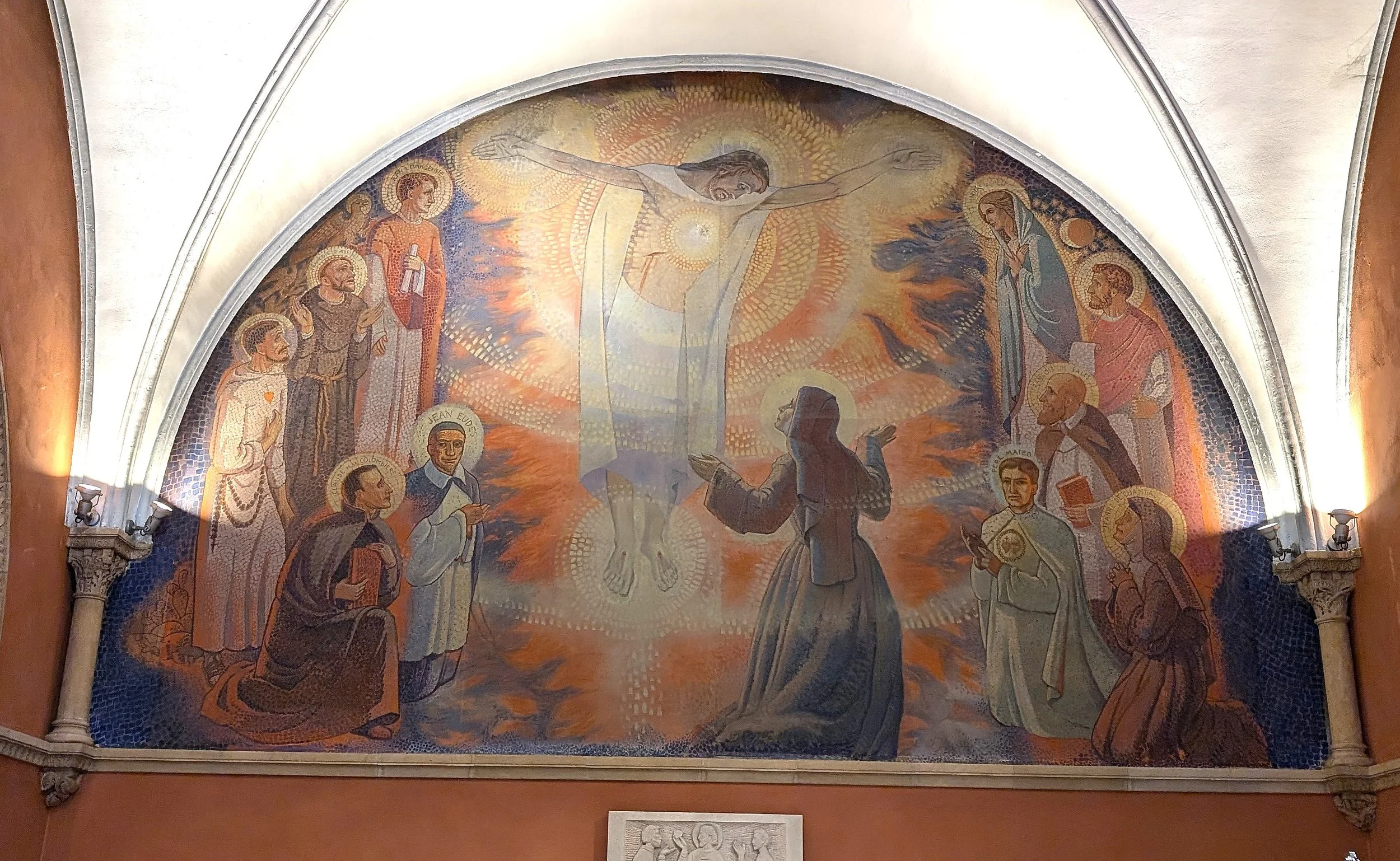
“For God, who commanded the light to shine out of darkness, hath shined in our hearts, to give the light of the knowledge of the glory of God in the face of Jesus Christ.”
May the light of God’s love
shine into the diamonds of our hearts
cleansing and liberating
so we may perfectly
and uniquely
refract the Divine Light!
This is post 6 of a 7 part series. Next up is the Devotion of Love.
Image Credits:
Artwork by Jose Luis Castrillo (browse his website here) (Instagram).
Tabernacle at the Chapel of the Visitation, Paray-le-Monial, France. Photo taken myself, 2024.
Image drawn myself as a prayer on an index card, 2025.
Mosaic at the Chapel of the Visitation, Paray-le-Monial, France. Photo taken myself, 2024.