The Heart of Love
This is the first post of a series of reflections on the science of love, revealed through the Heart of Jesus.
“Everything finds its unity in the heart, which can be the dwelling-place of love in all its spiritual, psychic and even physical dimensions. In a word, if love reigns in our heart, we become, in a complete and luminous way, the persons we are meant to be, for every human being is created above all else for love. In the deepest fibre of our being, we were made to love and to be loved.”
Ah! The Love of God! I could write days on end of her beauty! She is the Mother which births us, the Sage which guides us, and the Friend which comforts us… I know I can never grasp this Love with my intellect, for my mind is but a flower on Its vine and a wave in Its ocean. Yes, the Love of God is a vast ocean — full of mystery and darkness, yet also teaming with life and beauty — and all I want is to swim and explore its wonders for the rest of my life!
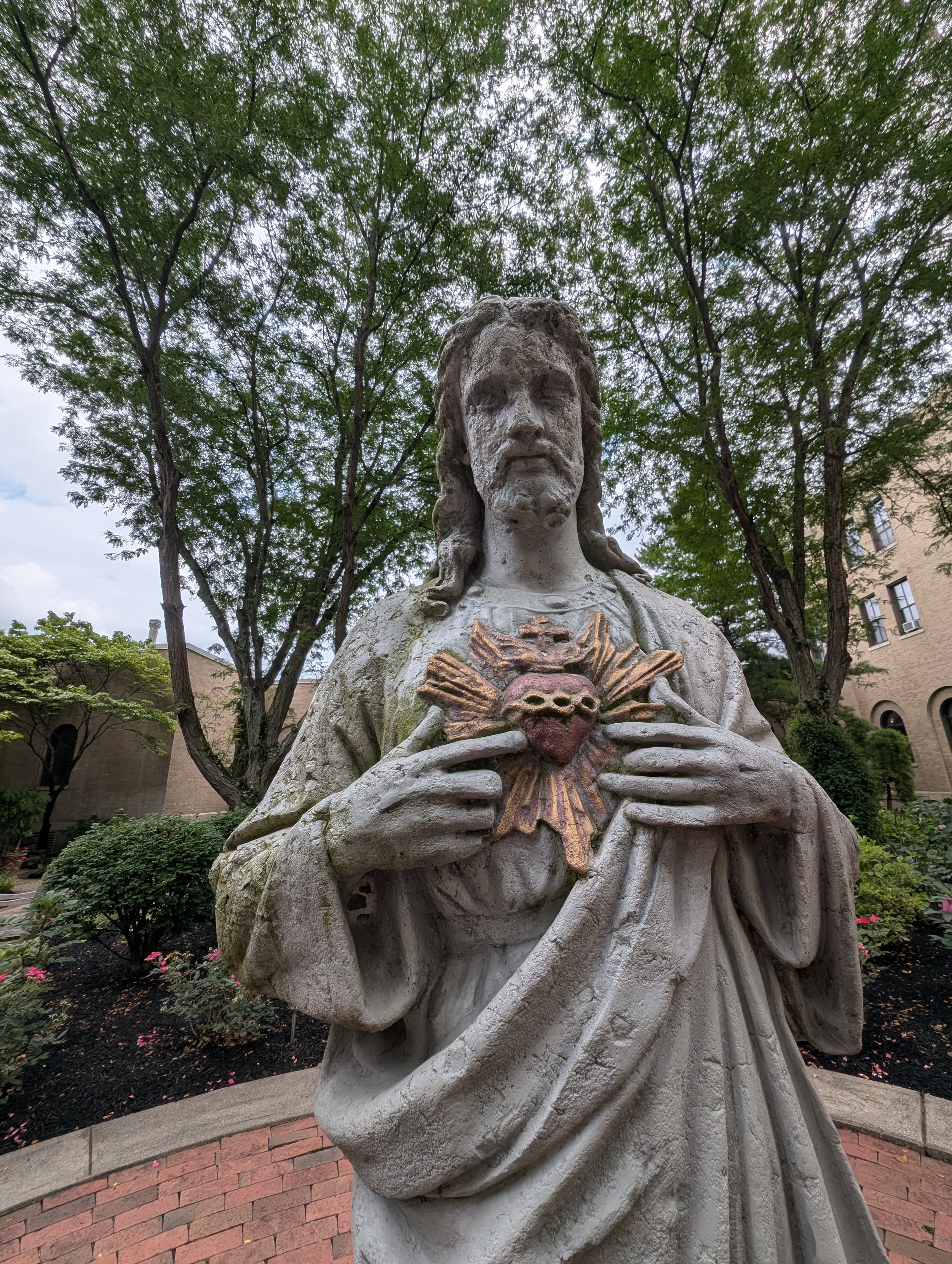
The Love of God is revealed to us through many avenues, but none more complete than in the living icon of God — the person of Jesus (2Cor4:4). Christians since the beginning of following the Way have contemplated the Heart of Christ… seeking to better understand and receive the Love of God, like John the Beloved, who himself rested upon the heart of Christ in the last supper (Jn13:23). By meditating upon the Sacred Heart as a symbol of Christ’s Love, I have come to better understand and yeda (יָדַע: experientially know) what the love of Christ really is.
The Power of Symbolism
When it comes to our spiritual growth, symbols are not superfluous, but always play an indispensable role — for symbols are intermediaries between the highest truths and our personal experiences.
To make a quick appeal to how this works: consider an abstract concept like “justice.” Try to hold it in your mind without visualizing/imagining anything. Is that even possible? I end up imagining something like Lady Justice (with her sword, scales, and blindfold), or a judges gavel, or an image of equality (like diverse people standing on the same level). These are images which help us to understand the concept of “justice…” and insofar as the images fulfill this role, they are symbols. As I consider the “sword” of justice, I can better understand the concept of justice (that it’s decisive, clear-cut, powerful, etc.)… perhaps I realize also that for a sword to make a clean cut, it must be a balanced weapon, slicing in a fair way, unweighted to either side… and this new understanding of justice can then “move back up” to re-inform my symbol of justice… and I can then see why the “scales” of justice are so important… and then contemplate the “scales” as a symbol to further enlighten for me: “justice.”
Through symbols we develop a relationship with abstract values/concepts. We use a symbol to discover insight about the concept (which “comes down” through the symbol), and then our new insight “goes back up,” to re-inform our symbol, and then we can use our updated symbol to discover new insights about the concept… in a reciprocally informing loop. Thus, symbols are the medium through which we relate with and are transformed by spiritual realities. (Note: It is in this way that Christ as a symbol transforms our relationship with God… the power of this symbol being bound up with Christ as metaphysical and epistemological reality.)
As one who wishes to study the science of love, I am always looking for symbols which help me to know and love Love itself.

What’s in a Heart?
In this series, we will examine the elements of the symbol of Christ’s Heart — a Love which is Fire, Blood, Cross, Crown, and Light. But first, we must examine the symbolism of a “heart” itself. Before this though, I want to extend to you an invitation — that as we move through these reflections, you bring your own heart. Spend time feeling throughout this series, gazing through images to the Love shining beneath, and noticing God’s whispers in your heart… for God, in his infinite wisdom, ordained that truth would not be communicated merely through words and the mind, but through art and the heart.
The heart is often considered the seat of love. It rests in the center of the human body — between the mind and the gut — and thus the heart binds together our abstract thoughts, values, and intellect with our concrete actions, skills, and instincts. It not only mediates between them but gives life to them… pumping blood to every muscle and organ — sending energy and warmth to each part, according to its need. The heart rests alongside the lungs… a fitting pairing, for the heart is the great connector within the self, and the lungs are the great connector between self and world. The lungs are a testimony to our constant dependency. We must receive oxygen from outside ourselves, so that our insides can be nourished. Lungs move ruach (רוּחַ: air/spirit), and the heart moves dam (דָּם: blood). Just as the air we receive oxygenates our blood, the spirit we receive enlivens our love! The love pumping through our heart, imbued with the life of the spirit, binds together all that it nourishes.
“In classical Greek, the word kardía denotes the inmost part of human beings, animals and plants . . . In Plato, the heart serves, as it were, to unite the rational and instinctive aspects of the person, since the impulses of both the higher faculties and the passions were thought to pass through the veins that converge in the heart . . . At the same time, the heart makes all authentic bonding possible, since a relationship not shaped by the heart is incapable of overcoming the fragmentation caused by individualism . . . We see, then, that in the heart of each person there is a mysterious connection between self-knowledge and openness to others, between the encounter with one’s personal uniqueness and the willingness to give oneself to others.”
The Nature of Christ’s Heart
The heart of Christ was drawn to the poor, the weak, the disregarded, the broken and downtrodden. Jesus ate with “sinners” (Luke 5:29-30), touched those who were “unclean” (Luke 5:12-13), called the poor blessed (Luke 6:20), lived his own life wandering with very little means (Luke 9:58), condemned those who were rich (Luke 6:24) and religious leaders who took advantage of the weak (Matthew 23:14), he loved children (Matthew 19:14), and he encouraged including the disabled (Luke 14:12-14) and accepting those of stigmatized races and religions (Luke 10:25-37).
It was from the heart that Jesus was “moved with compassion” to heal a diseased man (Mark 1:41) and from the heart Jesus was “consumed by zeal” against the injustice of the temple (John 2:15-17).
Christians believe that Jesus reveals to us what the heart of God is truly like… that whatever mattered to Jesus matters to God. Whatever Jesus pays attention to, God pays attention to. Whatever are Jesus’ priorities are God’s priorities. Thus, Jesus’s heart shows us that God lives with and blesses the oppressed, the slave, the outcast, the foreigner, and the refugee, and that God seeks liberation for all — freedom physically, socially, mentally, and spiritually.
In the face of a world which turns people into products and ignores the needs of the weak, the heart of Christ empowers us to take up arms for love, and work to restore relationality, dialogue, openness, and the full recognition of human dignity as imagers of God. Agents of Christ’s heart are all those who work towards global communion (common-union), by which all are loved and can share in the joy of continually extending love to others.
“The heart of Christ is “ecstasy”, openness, gift and encounter. In that heart, we learn to relate to one another in wholesome and happy ways, and to build up in this world God’s kingdom of love and justice. Our hearts, united with the heart of Christ, are capable of working this social miracle.”
God’s heart throbs for us. And each of us can be infused with Its beating love… a love which restores our vitality as an ever-flowing stream, enabling us to love with Its love — a love which is truly human and truly divine… a Love which binds all things (Colossians 3:14), bears all things (1 Corinthians 13:7), and never fails (1 Corinthians 13:8).
The symbol of Christ’s Heart reminds us of these things… and many more, which we shall soon explore together.
The next post is on 🔥The Fire of Love.
Note: Dilexit Nos (He Loved Us) is a 120 page Encyclical Letter from Pope Francis, with some most excellent reflections upon the heart of Christ.
Note: I wrote about each aspect of the Sacred Heart in a 1-pager here. This series of blog posts will further explicate each feature of the Heart.
Image Credits:
Statue at the Holy Spirit Center, Cincinnati. Photo taken myself, 2025.
Art by Michael Corsini, who makes truly beautiful sacred art (browse his website here) (Instagram).
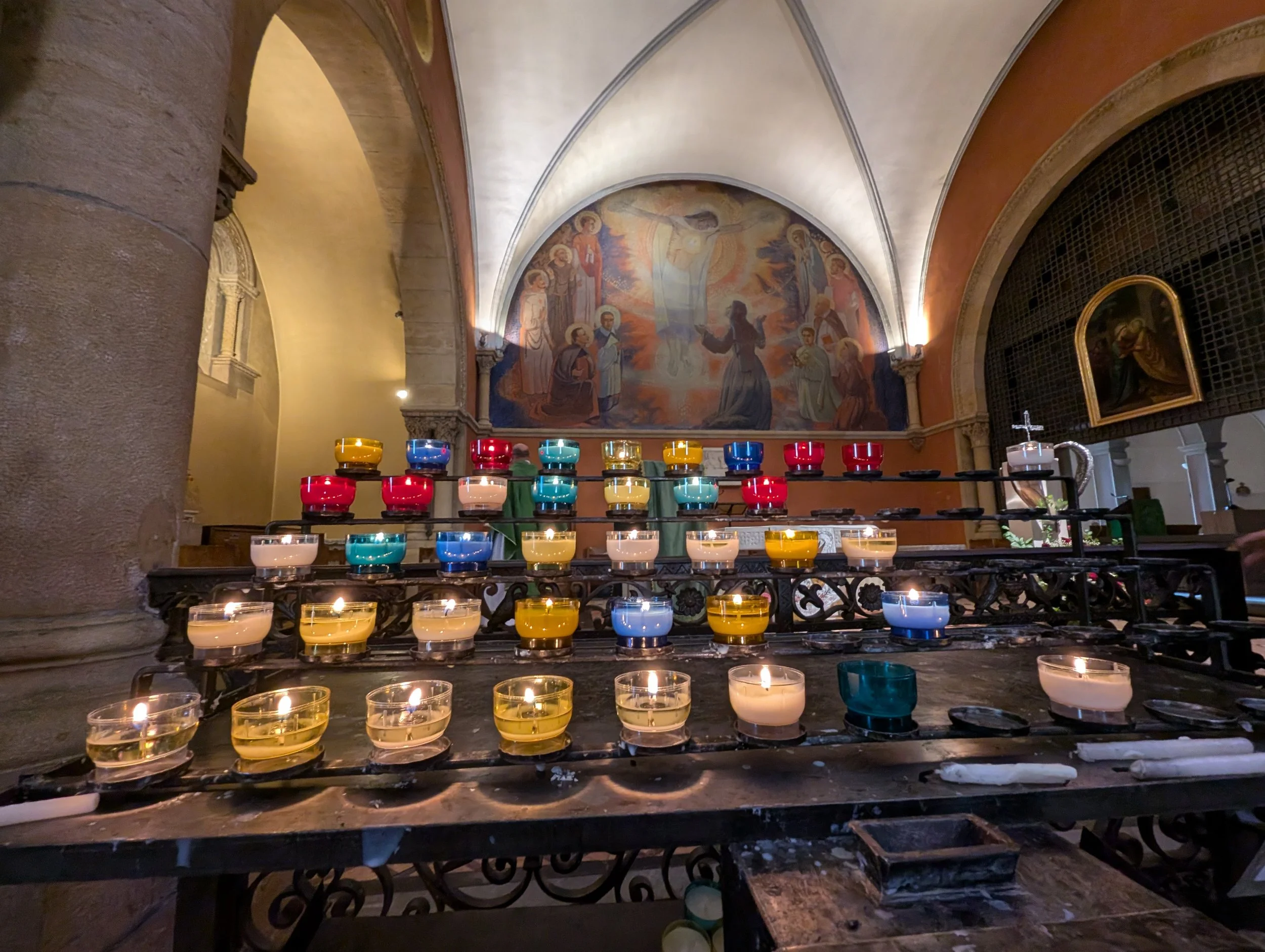
Chapel of the Visitation, Paray-le-Monial, France. Photo taken myself, 2024.